Looking outwards — three essential rules of product strategy
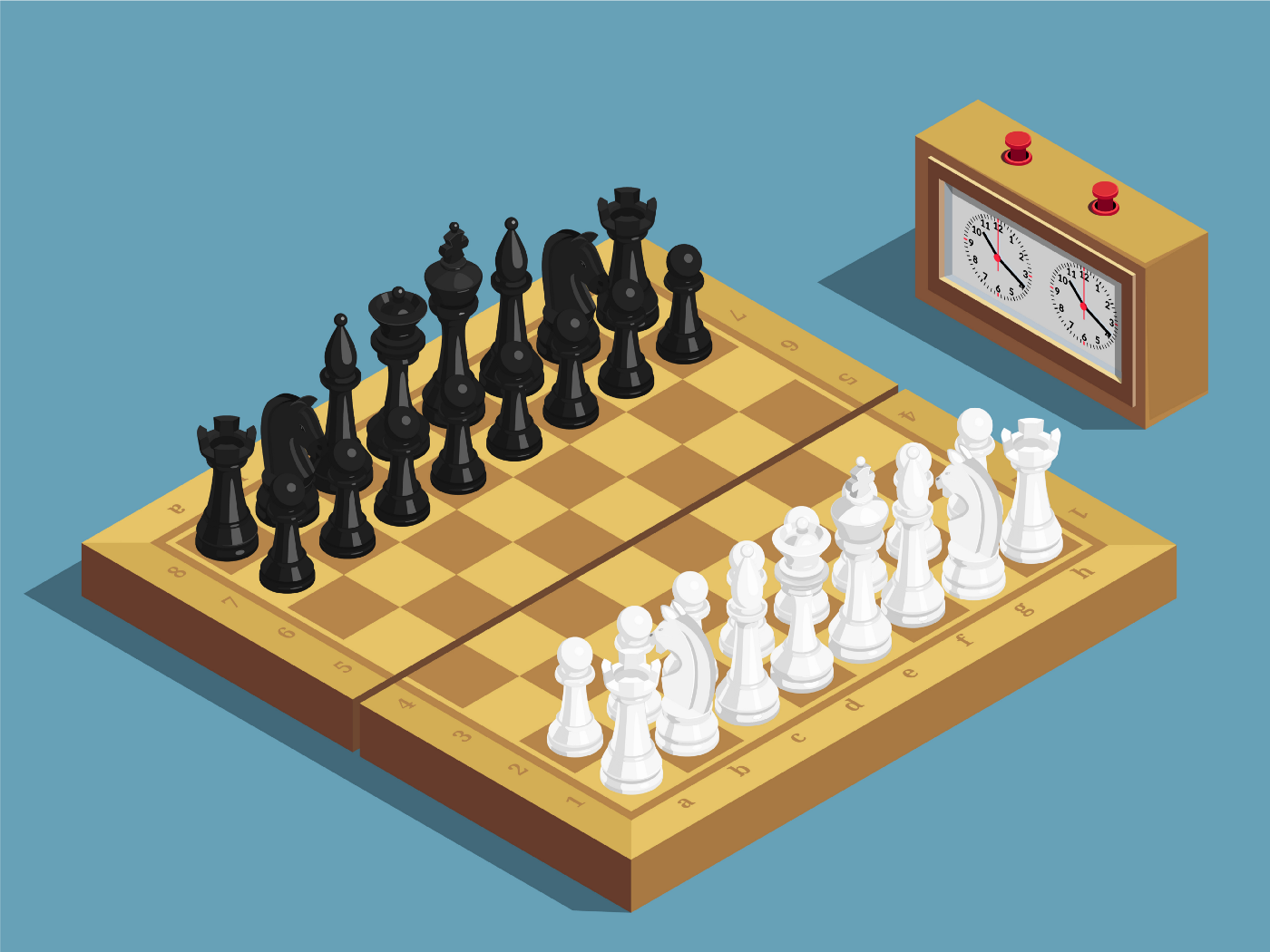
The conventional wisdom is that the best chess players win because they are able to see more moves ahead. So you may be surprised to hear this from world champion Magnus Carlsen:
“You have to take it move by move. It sounds contrary to what most people think goes on in chess. But often there are just so many possibilities you cannot think more than a couple of moves ahead.”
Carlsen summarises some of the essential ingredients of effective product strategy, which are also often contrary to what most people think.
A conventional framing of product strategy might be to focus on understanding and solving user needs, then setting a clear product vision and success metrics. But in my own experience, and looking at stories from many successful teams, the common advice often misses three essential rules — three rules which look outwards:
- Embrace competition
- Leverage trends
- Plan for change
Embrace competition
“Ignore your competitors”, they say. And sometimes that makes sense, especially when trying to solve a problem in a fresh way. But it is also naïve and, let’s be honest, a bit lazy.
In the end, products are competing to meet a need. You can’t ignore that competition — in fact, it seems the most successful companies have no qualms about studying, and directly challenging their competitors.
At the launch event for the first iPhone in 2007, Steve Jobs was clear. Five minutes into his presentation, he showed this, and spoke dismissively about “the usual suspects”:

Jobs understood that Apple was entering a competition to be the one device in your pocket.
Embracing the competition means using competitive tactics. Things like investing in strong marketing, prioritising features that are marketable or will demo well, and understanding what objections or questions you face ahead of a sale.
These tactics don’t necessarily feel good. But they work. And they belong in your thinking about product strategy and development.
Leverage trends
Gibson Biddle was VP of Product during the rapid growth of Netflix. His core question is, “How will your product delight customers, in hard to copy, margin-enhancing ways?” One essential factor is leveraging external trends — Gibson Biddle calls this “riding waves.” At Netflix they rode the rapid growth of internet bandwidth and streaming technology, and the new generation of better, cheaper smart televisions.
For a counter example, watch the documentary General Magic, chronicling the failed attempt to create an iPhone-like device in the early 1990s. A great team, with a great idea — and a great failure.

The team were so focused on their internal vision of the future, they both missed the opportunity created by the emergence of the internet, and failed to create a great product experience based on the viable technologies of that time.
Wardley Mapping is a tool designed to generate an objective, outward-facing conversation about user needs, the technologies being used, and how both will evolve over time. Simon Wardley shared this image on Twitter — a very old map of his that he used to explain what was going wrong with Kodak:
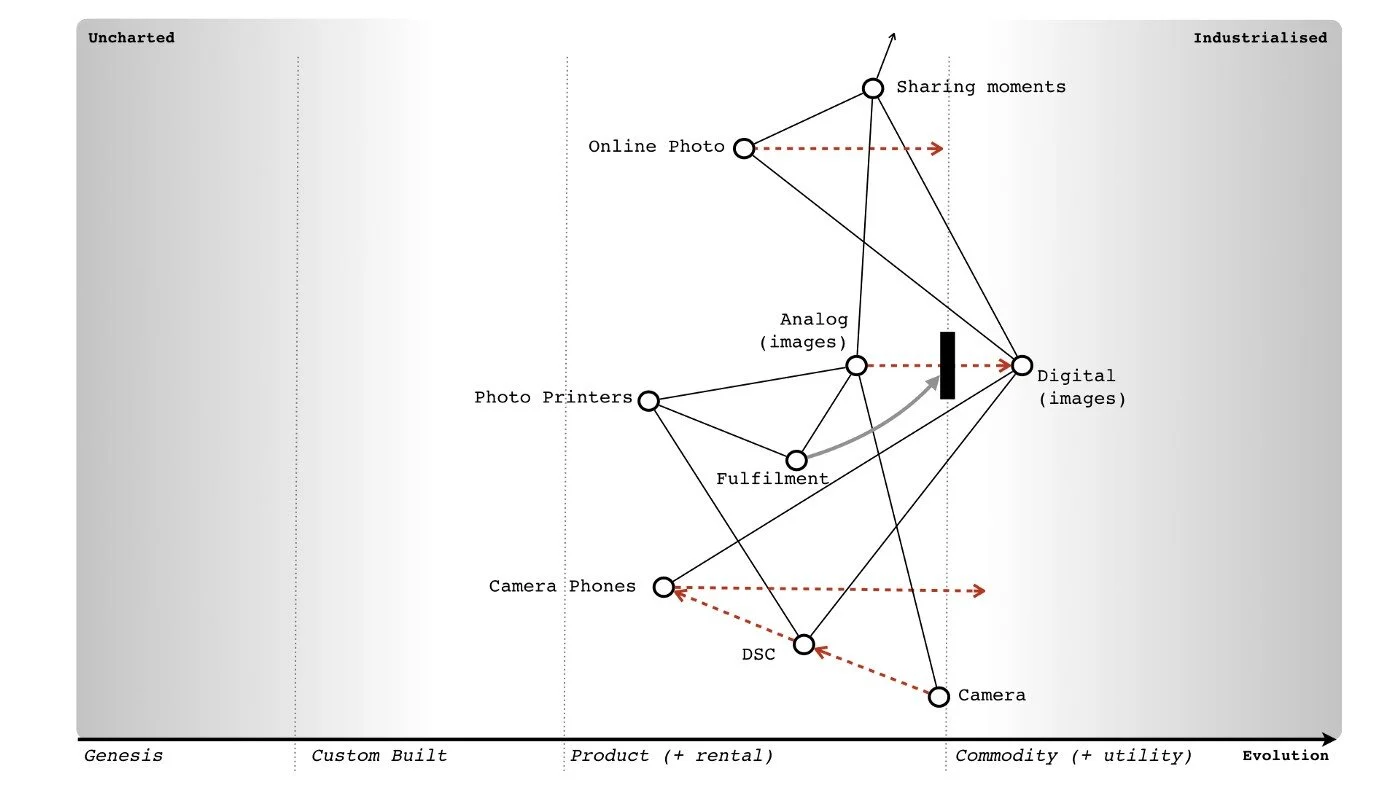
The map shows how the need of “Sharing moments” was being met with both analogue and digital cameras. The dotted red lines illustrated the ongoing, rapid evolution of online photos and camera phones, which would transform the market and devastate companies like Kodak.
Plan for change
When you look at examples like the iPhone or Netflix, it can feel as if the best products appeared as a result of a perfect, pre-determined plan. But the reality is often depicted like this:
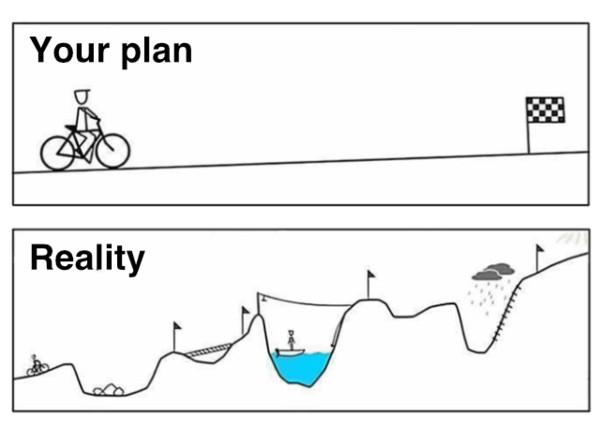
You shouldn’t just be iterating on how you get from A to B. You should also be iterating on what B is. Because product strategy is not one fixed, predestined ascent.
Richard Rumelt writes brilliantly about this. He talks of strategy as ideally a “non-annual, opportunity-driven process”:
“You can’t get rid of ambiguity and uncertainty — they are the flip side of opportunity. If you want certainty and clarity, wait for others to take a position and see how they do.”
In my own work, I am increasingly clear with colleagues about the unknowns. For one previous project I made a roadmap of ‘possible futures’, which showed how we might choose various paths of complementary features:
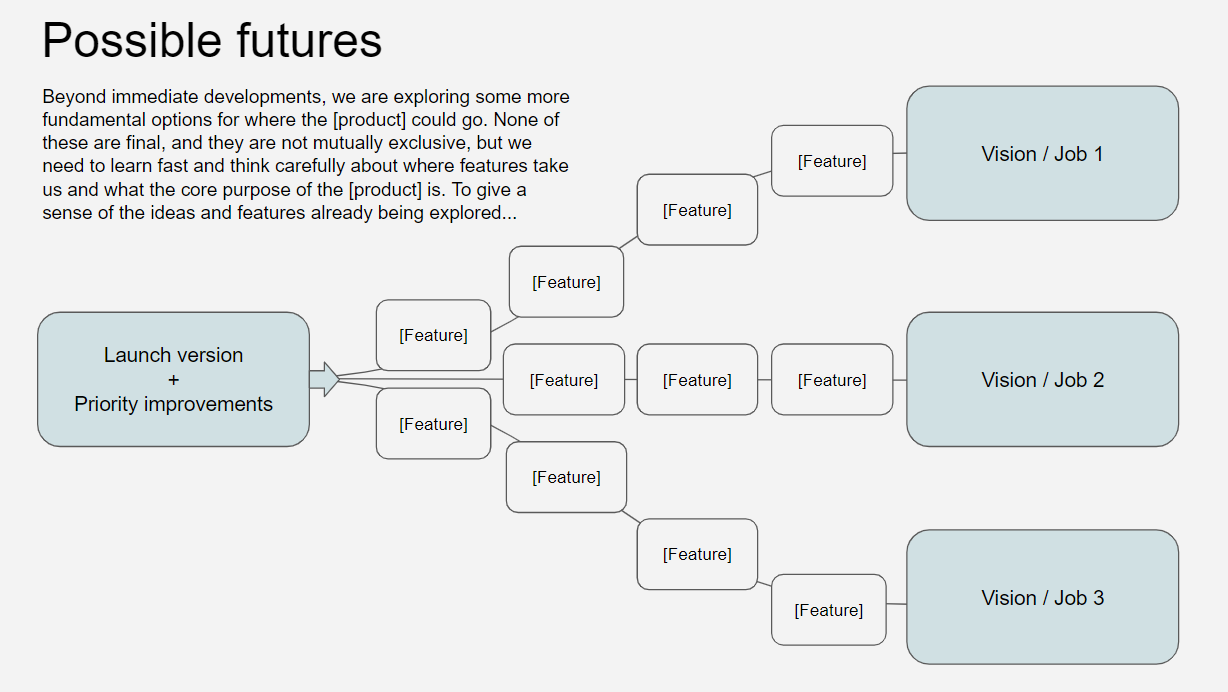
Rather than a Gantt chart or timeline, our current roadmap is a narrative document that starts with a strategic overview, before breaking down each product area into “Current priorities” and “Longer term we are thinking about.”
When the Apple Watch was launched in 2014, Tim Cook described it as three things: a timepiece, a communication device, and a health and fitness companion.

Now the Apple Watch homepage looks like this:

Apple’s product vision evolved — both in response to initial feedback and the Coronavirus outbreak. In many ways the three things listed in the original launch were ‘possible futures’ — and health and fitness proved to be the winner. Nobody would accuse Apple of a lack of focus. But the story of the Apple Watch shows how they too are experimental, responsive, and opportunistic.
Back at the chess board
Richard Rumelt says “being ‘strategic’ largely means being less myopic.” The rules above are all about breaking our natural propensity to over-plan, resist change, and underestimate external factors.
Which brings me back to Magnus Carlsen:
“Often there are just so many possibilities you cannot think more than a couple moves ahead. And if up against a strong opponent, he or she will realise what your plans are.”
The great grandmasters are the ones who can handle this balance — the need for a great Plan A, but also the situational awareness, the ruthless opportunism, and the flexibility of mind to respond to change.